"Who are you, O priest of Jesus Christ?"
© Mazur/cbcew.org.uk
"What do you want to be when you grow up?" We sometimes ask children. Most children don't really know, nevertheless that's the right question to ask. The wrong question to ask is, "what do you want to do when you grow up?" This is simply because who you are is infinitely more valuable and important than what you do. Although we must be honest, the two things are inextricably linked. "Who are you, O priest of Jesus Christ?" That is the question we must contemplate and ask ourselves frequently before ordination and continuously afterwards, and a question those of us not ordained might ask of our priests in order to encourage them.
St John Paul II gave us a lead in this meditation with his penetrating teaching on the subject in his Apostolic Exhortation Pastores Dabo Vobis (March 25, 1992). Here he is at pains to offer a vision of the Sacrament of Orders after the vision of Vatican II and gives us a confident understanding of our identity as priests. He offers us words from the Holy Scripture to help us trace our way into this mystery of the Priesthood.
"I will give you shepherds after my own heart." (Jeremiah 3:15) He linked this familiar text to the Person of Our Lord Jesus the Good Shepherd, meaning of course, not only good but the noble and ideal shepherd who lays down His life for His sheep. No other model of priesthood would satisfy the Pope, other than Jesus. St John Paul himself had a heart that desired to renew and refresh the sacred priesthood which in some places and some circles had lost its lustre and lost its way.
As shepherds in the Church, we need continually to ponder what kind of heart the Lord is describing, what it is like and how we are to acquire it. How can our hearts be shaped to become like His? This is our constant watchfulness. The more we ponder Holy Scripture the more do we become conscious that the Heart of the Father is being disclosed to us throughout. We might frequently pray for the Gift of Understanding that Confirmation promises from the Spirit in order to perceive, even in the revelation of the Old Testament, where the Father's heart can be traced in His Covenants, in His Commandments and through His holy prophets. We would do well to consider the surrounding text of Jeremiah i.e. 3:14-16a:
Return, O faithless children, declares the LORD; for I am your master; I will take you, one from a city and two from a family, and I will bring you to Zion. "'And I will give you shepherds after my own heart, who will feed you with knowledge and understanding.
© Mazur/cbcew.org.uk
The Father's heart yearns for His people to return to Him. It is almost an impatient longing for the heart that has strayed to find its way back to His Heart. Jesus will later say in St John's Gospel "If anyone loves me, he will keep my word, and my Father will love him, and we will come to him and make our home with him. Whoever does not love me does not keep my words. And the word that you hear is not mine but the Father's who sent me." (Jn 14:23) What Jesus announces at the beginning of His ministry when He calls the crowds to "repent because the kingdom of God is close at hand" is just such a call to holiness of life and a call to divine intimacy.
For the Bishop, priest and deacon this is his guiding motif: to call men and women to holiness of life, i.e., to find their hearts' true home in the Heart of Jesus Christ. This can only happen if the person in Orders himself has set out along the path into that Heart and has begun to discover something of the rich tenderness and mercy to be found in its chambers.
Let's think of it another way: When we are ordained Jesus comes to inhabit us and act through us in such a way that He can generously serve His brothers and sisters in the Church, strengthening them in turn for merciful service. Holiness, you might say, is giving Jesus permission to live His life in and through our own thoughts, words and actions. To become a Sacrament of Service in Holy Orders is to allow Jesus to take us over for sacred ministry in our own age. Of course, this also is true for all the baptised who also participate in the common priesthood of the faithful. But in the bishop and priest this is lived in a particular way with a particular efficacy. At the ordination of a priest Christ, whose heart was pierced, somehow pierces the heart of the priest in the silence of the laying on of the bishop's hands. Similarly, Christ who bore the scars of His glorious wounds in His hands, somehow pierces the hands of the priest when the oil of Holy Chrism anoints them ready for consecration, absolution and blessing.
The Liturgy offers us a further entrance into contemplating the mystery of the priesthood. The three sacred furnishings at which the priest stands during Holy Mass, the Presidential Chair, the Lectern and the Altar reveal the priesthood of Christ. At these three places Jesus Christ, our Eternal High Priest, discloses His threefold service as Priest, Prophet and King. This is how He lives in His Church, how He ministers to His Body the Church and how He desires us to live through our lives in homes and schools, in politics and in private to be witnesses to His Crucifixion and Resurrection.
© Mazur/cbcew.org.uk
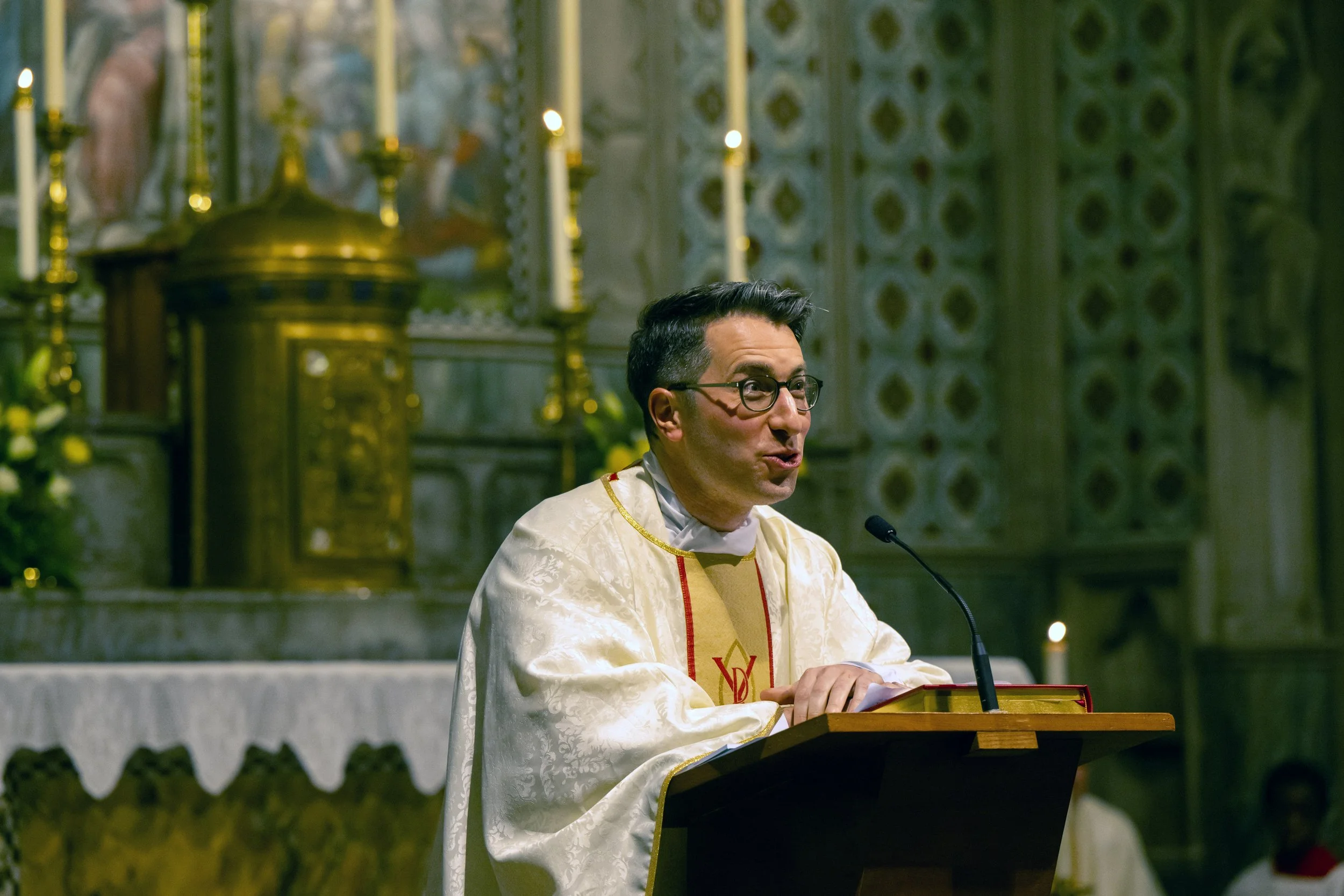
At the Lectern, where the word of God is proclaimed, Christ Himself speaks to us. This is where the mystery of faith is proclaimed, explained and prayed. It signifies the prophetic mission of the Church to speak the truth in justice and love to a world, often starved of clarity and truth, and longing for wisdom that comes from above. This is where our faith and hope are sustained, nourished and deepened.
At the Altar, where the Sacrifice of the true and living Lamb is made, Jesus offers Himself to the Father for our good and for the good of His holy Church. This is where, through Jesus' own sacrifice we intercede for the world. He carries us to the Father and presents all those for whom we offer the Sacrifice of praise and thanksgiving. And in return this is the Table from which He feeds us with Himself. This is where we are strengthened for generous service, united to our brothers and sisters, and furnished with the peace that comes from the Risen Lord that we carry out to all whom we shall encounter until the next Mass.
At the Presidential Chair, Christ presides over His Body the Church. Here we experience Him as King and Shepherd, Merciful Judge and Father of our souls. This is where He orders the charisms and gifts of the faithful so that through good governance the Body of Christ works in communion and in harmony. This is how we can manifest the variety of Gifts of the Spirit that we have been given in lifelong witness to the men and women in our world, sharing those gifts with them, since all gifts are given to us to be given away.
In these three ways a bishop and a priest and a deacon too, express ministerially the glorious hidden life of Jesus Christ among us. In so doing they enable the religious and the lay faithful to take up their rightful places as priest, prophet and king in the world that they have received by virtue of their Baptism and Confirmation.
We all have to realise that our Baptism will eventually lead to the Cross. And that only deepens as we live out our priesthood faithfully day by day. The three munera (offices) of Jesus Christ, of priest, prophet and king, only serve to break our hearts so that they can be more open to serve, and more deeply and more intensely love those we encounter along the way. Governing is tough because it meets those who do not want to be guided or who want things to stay the same as they have always been. Being a shepherd is painful when we have to take difficult and unpopular decisions. Governing is a cross when we are obliged to live from our limitations and weaknesses, and when we have to do things for which we are not naturally gifted. The teaching ministry is tough when people resist being taught, or who are not interested in the Gospel. Living the prophetic gift of Christ is hard when people will not accept the teaching handed on to us by the Church. The teaching ministry is lonely when it appears to fall on indifferent ears. Christ's ministry of sanctification and prayer is tough when we feel that we are being used, when prayer seems arid and lifeless. The ministry of priest is tough when it meets a culture that prefers comfort and convenience to discipleship and holiness.
© Mazur/cbcew.org.uk
BUT, and HOWEVER, there is a deep and great joy to be found if we persevere in watchfulness and prayer. The vocation of Holy Orders is always shot through with the glorious presence of the Crucified and Risen Christ. His joy is ours and to claim it we must daily pray to see it. Let us pray to become more sensitive to it, praying and longing to recognise the ever-present mystery of Grace in which we are steeped. This must become a habit of the heart. We must intentionally pray that we habitually live in that presence. Eventually the habit becomes part of the spirituality of those who must live in the world and yet contemplate the heavenly mysteries while they live there. I find it helpful to think that we must experience a sort of Lectio Divina with both our ears. One ear is given to listen prayerfully to the movements of the Spirit speaking gently within our hearts both in the meditation of Holy Scripture and in the listening in silence which is the language of God. Then we must learn to listen with the other ear, to the movement and voice of the Spirit in the activity and service of everyday life, however mundane and routine our work. We will learn to recognise the voice of Grace even in cleaning the gutters and dealing with complaining emails, as well as the joys of the school and delights of a baptism ceremony. We will become more sensitive to the movement of the Spirit in other people's lives, sometimes even when they cannot quite recognise it themselves. Listening to God makes us very much more sensitive to listening to others and to listening to Him speaking within them.
And there is joy in abundance in this way of living out humility and poverty. Joy is to be cherished and found among those who come really desiring to know Jesus Christ and to live His life, in those who want to learn more about the Scriptures and the teaching wisdom of the Church. There is a palpable joy when we find those who wish to serve as missionary disciples and witness with boldness to the Lord. Joy lived out genuinely is contagious. True disciples foster other disciples. Servants of Jesus attract service in other people and draw out from them generous hearts: hearts like that of the good shepherd.
"Who are you, O priest of Jesus Christ?"