Saint Gregory Nazianzen on the Priesthood
Life and Context
Saint Gregory Nazianzen is one of the great doctors of the Church, and a figure of particular importance for priests. Those familiar with Saint John Vianney (the patron saint of priests, known in part for the fact that he fled from his ministry on several occasions) will find a similar spirit in Gregory. He, too, ran away from his priestly responsibilities more than once, and it is precisely after his first flight that he returned and wrote what has become one of the most significant texts in the history of priestly spirituality: his Second Oration, composed in 362 AD. It is that text which forms the subject of this article.
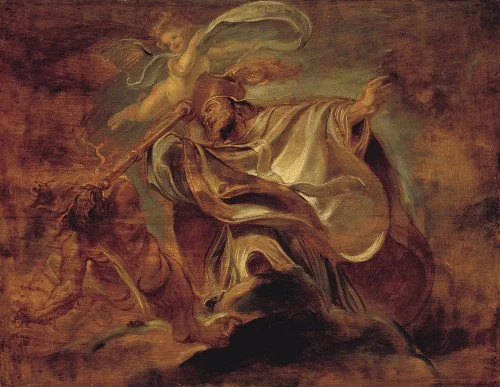
Saint Gregory of Nazianzus Subduing Heresy, Peter Paul Rubens
Gregory was born in 329 in Cappadocia, in what is now Turkey. His formation was exceptional by any standard. He studied rhetoric and philosophy first in Cappadocia, then in Alexandria in Egypt, and finally in Athens, where he forged his friendship with Saint Basil, who would himself go on to be ordained and eventually consecrated a bishop. Gregory was by both talent and temperament a poet: his prose is beautiful, precise, and often sharply witty, but he also had the poet's volatility of spirit.
On returning to Cappadocia, Gregory joined Basil in the monastic, contemplative life, and the two collaborated on a number of theological works. Then, suddenly, in 361, Gregory's father, who was himself Bishop of Nazianzus, summoned him from that life and ordained him a priest, largely against his will. The fact his father was a bishop should not cause surprise: in the early Church, priests and bishops were often chosen from married men who began to live celibately after being called. But despite the call coming from his own father, Gregory promptly fled. When he returned, he wrote his Second Oration, which sets out the reasons for his flight and, in doing so, articulates a profound theology of the priesthood.
The subsequent trajectory of Gregory's ecclesiastical career was, to put it mildly, eventful. He was appointed Bishop of Sasima by Basil, a move that reflected Basil's considerable political shrewdness: Sasima was a contested ecclesiastical territory within Basil’s jurisdiction and by making it a separate diocese, and its bishop a friend, Basil could exert greater influence for the cause of orthodoxy. Gregory duly became Bishop there, but then fled again to the eremitic life. He was persuaded to serve as coadjutor bishop in his home town of Nazianzus, but when his father died in 374, he left once more, this time for Syria.
It was from Syria that Gregory eventually made his way to Constantinople, and it is there that his ministry reached its true flourishing. At that time, Constantinople also had an Arian bishop, and Gregory established himself in a small church known as the Anastasia (the Church of the Resurrection) where he composed some of his greatest theological works, above all the five Theological Orations, with their commanding treatment of Trinitarian and Christological doctrine. In time, and with the support of the Emperor, Gregory became the sole bishop of Constantinople, and presided over the great Council of Constantinople. He was, however, accused during that council of having transferred from one see to another (from Sasima to Nazianzus) which was contrary to Canon Law at the time. He resigned, allowed someone else to complete the council's work, and returned to the eremitic life. It was a dramatic ecclesiastical career, marked throughout by the tension between his longing for contemplative solitude and the pressing demands of office.
Gregory's Theological Legacy
Gregory is perhaps most celebrated for his contribution to the theology of the Trinity. Together with the other Cappadocian theologians, Basil and Gregory of Nyssa, he engaged with the Arian controversy not merely by refuting its errors but by taking its better insights seriously and synthesising them within an orthodox framework. This proved to be the most effective response to the heresy.
Even within the Cappadocian circle, Gregory was notable for his theological boldness. He wished to affirm not only that the Son was consubstantial with the Father, but that the Holy Spirit was likewise consubstantial with the Father, a claim that is, of course, true, and that the Church would later formally teach. Basil, the canny political operator, demurred: he feared that pressing this language too hard might alienate some orthodox allies who were not yet ready to embrace it. Gregory the thinker, by contrast, was unwilling to sacrifice theological precision for ecclesiastical strategy. It was also Gregory who articulated the distinctive mode of the Spirit, ‘proceeding from the Father’, drawing on the language of John's Gospel and using it as a way of distinguishing the Spirit from the Son without reference to their activity in the world, thereby demonstrating both the Spirit's distinctness and his divinity.
Gregory could also be a formidable polemicist. Against the Apollinarian heresy, the teaching that Christ possessed no human intellect, he turned a characteristically sharp wit on his opponents: if Christ had no human intellect, he observed, then evidently neither did they.
The Second Oration: A Foundational Text on the Priesthood
The Second Oration is worth situating in its broader context. Readers familiar with John Chrysostom's celebrated treatise On the Priesthood (quoted in the 2013 Directory on the Life and Ministry of Priests) will find it illuminating to know that Chrysostom drew heavily on Gregory's text. The Second Oration is, in many respects, the fountainhead from which that later and better-known work flows. One theme they share above all is the presentation of Saint Paul as the model priest, a theme to which we shall return.
The text opens with Gregory's account of the reasons for his flight. He describes his ordination as having been carried out forcibly and almost tyrannically. He speaks of his love for the hermit's life, for philosophy (a word he uses to encompass theological reflection as well as the ascetic life) and, with striking honesty, he names a third reason: shame at the state of the contemporary clergy. He then moves into an extended account of the challenge of the priesthood, and it is in this section that his richest theological teaching is found. The text concludes with the reasons for his return: his love for his people, and above all, obedience. He likens his own situation to that of Jonah, a man grieved by the state of his people, whose reluctant response to God's call was delayed by that grief, but who ultimately obeyed.
What follows is an examination of Gregory's teaching under four headings: human formation, intellectual formation, pastoral formation, and spiritual formation, which will be familiar to those acquainted with the fourfold structure of priestly formation that has shaped seminary education over the past several decades. While Gregory does not use this framework explicitly, his text engages with all four dimensions, and the structure provides a useful lens through which to read him.
© Mazur/cbcew.org.uk
Human Formation
Gregory sets the bar for the priest's human formation deliberately high, though it is worth bearing in mind, as we read him, that he is partly making a case for why he himself was not ready for the office. Even so, the substance of his teaching here stands independently of its rhetorical purpose.
The priest, he argues, must ‘surpass the majority [of people] in virtue and in closeness to God.’ He guides the laity by both word and deed along the path of duty, and is therefore called to be a model for others. Gregory reaches for the image of precious metal to make the point:
He must, like silver or gold, […] never ring false or alloyed, or give token of any inferior matter, needing further refinement in the fire; (1 Cor 3:13) or else, the wider his rule, the greater evil he will be.
A priest who is not himself virtuous will spread vice rather than virtue. The reach of his influence only amplifies the problem. And the connection between the priest's character and his apostolic fruitfulness is drawn explicitly: 'the gospel should make its way no less by their character than by their preaching.’ Gregory also insists that the priest must be, in the phrase later used by Saint John Paul II, an expert in humanity. He does not use that precise expression, but the concept is present throughout. The priest cannot apply a single approach to every person, as if pastoral care were a matter of uniform procedure:
For men and women, young and old, rich and poor, the sanguine and the despondent, the sick and the whole, rulers and ruled, the wise and the ignorant, the cowardly and the courageous, the wrathful and the meek, the successful and the failing, do not require the same instruction and encouragement. Some are led by doctrine, others by example; some need the spur, others the curb; […] some are benefited by praise, others by blame, both being applied in season.
In some cases, Gregory observes with remarkable pastoral realism, it is better to appear not to notice a fault than to address it directly: repeated reproofs can drive a person to despair and ultimately to recklessness, stripping them of the very self-respect that makes persuasion possible. The priest must at times show an anger he does not feel, or a disdain he does not feel, or a despair of someone he has not truly given up on — all calibrated to the needs of the individual.
Throughout all of this, Gregory returns insistently to the theme of freedom. The priest cannot simply compel people:
Nor must [the priest] suppose that the same things are suitable to all, […] if indeed he is, by his high degree of virtue, to draw his people to an ordinary degree, not by the force of authority, but by the influence of persuasion.
He compares the work of guiding souls to the training of a plant, something that requires gentle movements, not forced or damaging ones. The image is pastoral in the deepest sense: patient, attentive, responsive to the particular nature of the living thing before one.
Intellectual Formation
For Gregory, preaching is the first duty of the priest, first not in importance but in order of chronology – he writes, ‘in regard to the distribution of the word, to mention last the first of our duties,’ – and to preach well, the priest must first know his faith, and know it with rigour and fidelity. Gregory will not allow the priest to soften or dilute the truth for the sake of popularity:
We are not as the many, able to corrupt (2 Cor 2:16-17) the word of truth, and mix the wine, (Is 1:22) which makes glad the heart of man, with water, mix, that is, our doctrine with what is common and cheap, […] to gain the special good will of the multitude, injuring in the highest degree, nay, ruining ourselves, and shedding the innocent blood of simpler souls, which will be required at our hands.
The priest is a defender of truth who must also be a skilled communicator of it. Gregory is acutely aware of how difficult this combination is. Teaching the faith, he observes, is beset by dangers from three sources: dangers arising from the teacher himself; dangers arising from the learner; and dangers arising from the subject matter. On the side of the learner, he notes a deeply human resistance to changing one's religious convictions:
The more fervent they are in the faith, the more hostile are they to what is said, supposing that a submissive spirit indicates, not piety, but treason to the truth, and therefore they would sacrifice anything rather than their private convictions, and the accustomed doctrines in which they have been educated.
The priest must therefore approach every person as a specific individual, with their own starting point and their own particular form of resistance.
The congregation, Gregory observes with characteristic vividness, might look prettier than a many-headed monster, but it has something of that creature's variety. Some need to be fed ‘with the milk of the most simple and elementary doctrines’; others can receive the ‘wisdom which is spoken among the perfect’. (1 Cor 2:6) The best foundation, he suggests, is always laid when people are young: they are, at that stage, ‘like wax not yet subjected to the seal’, on which good and firm impressions can be made.
Gregory also insists that the priest who wishes to direct others must himself be willing to be directed. To guide others well, one must be guided oneself:
We are aware that it is better to offer our own reins to others more skilful than ourselves, than, while inexperienced, to guide the course of others… to undertake the training of others before being sufficiently trained ourselves, […] and to practise ourselves in piety at the expense of others' souls, seems to me to be excessive folly or excessive rashness.
Pastoral Formation
Gregory's understanding of the priest's pastoral role has a grand, almost cosmic register to it. He describes the priest's relationship to the Church as analogous to the relationship of the soul to the body, or of the intellect to the soul. The priest is meant to be the guiding, animating principle of the whole community. And the model for this radical pastoral zeal is Saint Paul.
Gregory fixes particular attention on one of the most challenging passages in the Pauline letters, Paul’s declaration that he is ready, if it were possible, to be damned in the place of his Jewish brothers, so that they might be brought to Christ. Gregory's commentary is worth quoting in full:
He even was exceedingly bold on behalf of his brethren according to the flesh, (Rom 9:3) if I may myself be bold enough to say so, in his loving prayer that they might in his stead be brought to Christ. What magnanimity! What fervour of spirit! He imitates Christ, who became a curse for us. (Gal 3:13)
The priest is called to that same total self-gift: not to preserve himself at the cost of others, but to pour himself out for them, as Christ poured himself out for the world.
copyright: Mazur/catholicnews.org.uk
Gregory also reflects, with real depth, on the freedom that must characterise the priest's pastoral work. The aim of the priestly art, he says, is nothing less than to give the soul wings:
The scope of our art as priests is to provide the soul with wings, to rescue it from the world and give it to God, and to watch over that which is in His image, (Gen 1:26) if it abides, to take it by the hand, if it is in danger, or restore it, if ruined, to make Christ dwell in the heart (Eph 2:17) by the Spirit: and, in short, to deify, and bestow heavenly bliss upon, one who belongs to the heavenly host.
The priest gives souls wings; he does not chain them up.
Spiritual Formation
The core of Gregory's teaching on priesthood is reached in his account of the spiritual dimension of the priestly ministry. The priest's work is, at its heart, a participation in the sanctifying action of Christ. And in a reflection that resonates strongly with later Church teaching, Gregory insists that the priest is himself sanctified in and through the work of sanctifying others:
Of this healing we, who are set over others, are the ministers and fellow-labourers, […] to the advantage both of those who are in want of healing, and of those whose charge it is to heal.
This mutual sanctification reaches its summit in the liturgy, which Gregory describes as those 'mystic and elevating rites, which are our greatest and most precious privilege.' Through the sacred rites, the priest participates in the very priesthood of Christ, and is given the astonishing dignity of becoming, in some sense, an instrument of divinisation:
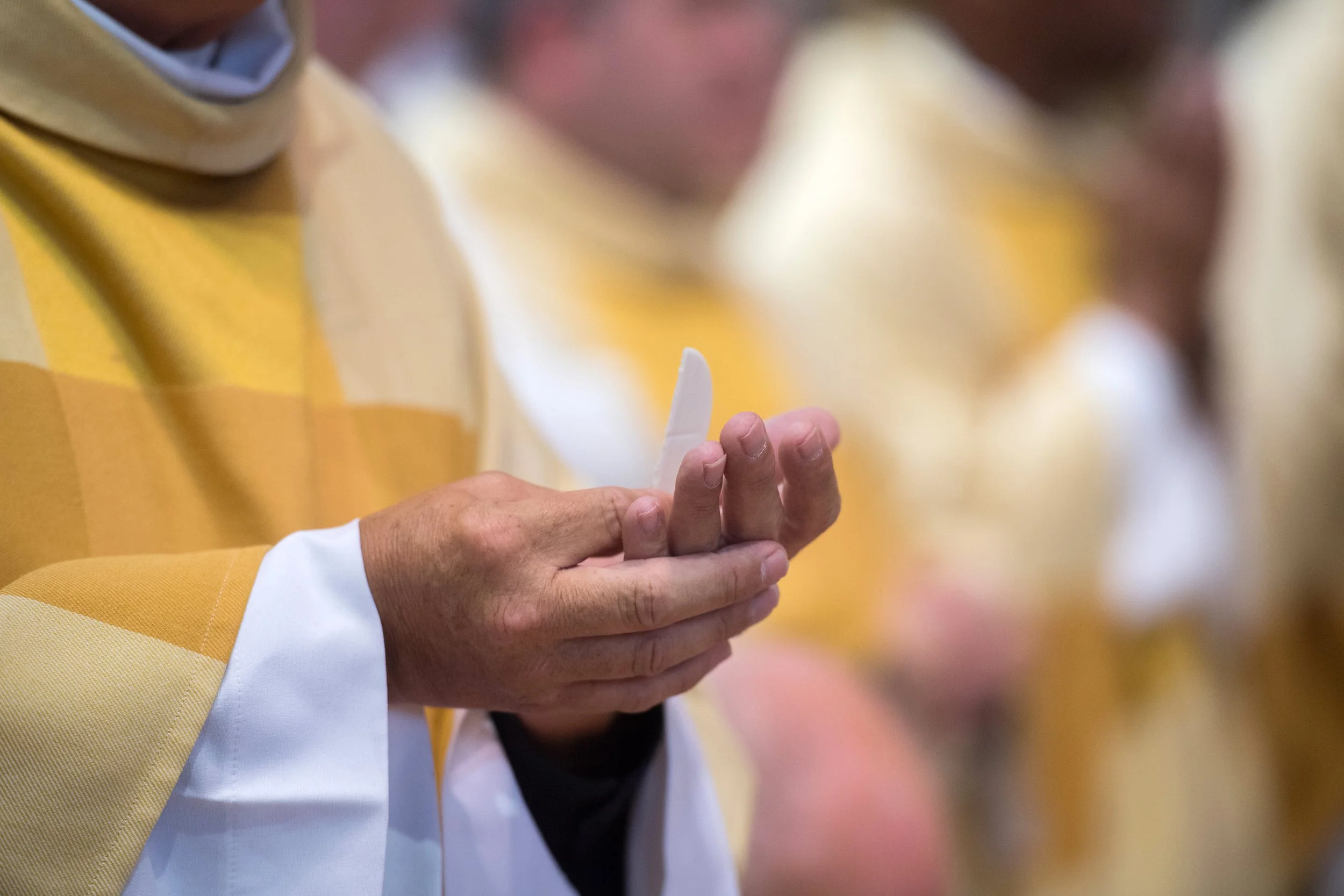
Who can mould, as clay figures are modelled in a single day, the defender of the truth, who is to take his stand with angels, and give glory with archangels, and cause the sacrifice to ascend to the altar on high, and share the priesthood of Christ, and renew the creature, and set forth the image, and create inhabitants for the world above, aye and, greatest of all, be God, and make others to be God?
copyright: Mazur/catholicnews.org.uk
The language is bold, but its meaning is precise: the priest is divinised, and through his ministry he divinises others. He is not a mere functionary or administrator of sacramental rites; his own holiness is intrinsic to the effectiveness of what he does. The holier he is, the more powerfully his ministry mediates grace. There should, therefore, be no resting on previous attainments:
He should know no limits in goodness or spiritual progress, and should dwell upon the loss of what is still beyond him, rather than the gain of what he has already attained.
The priest must himself be purified if he is to purify others:
'A man must himself be cleansed, before cleansing others; himself become wise, that he may make others wise; draw near to God, and so bring others near; be hallowed, then hallow them.'
Gregory finds in Saint Paul's example of bodily mortification, his glorying in infirmities, his buffeting of the body, a model for the priest's ascetical life. And ultimately, both the priest's example and his preaching must reflect the pattern of Christ himself: 'the gospel should make its way no less by their character than by their preaching.’
What Gregory Does Not Treat
Any honest account of the Second Oration must also acknowledge what it does not contain. Gregory says very little about celibacy or priestly fraternity. These omissions are, however, understandable in context. Gregory had already embraced the monastic life before being ordained; the question of celibacy was, for him, settled, almost assumed rather than argued. The text is less a comprehensive programme for priesthood than an account of what Gregory himself understood the priesthood to require, written in a particular moment of personal and ecclesial crisis.
Obedience receives rather more attention, and is in fact one of the central reasons Gregory gives for his eventual return. Having rehearsed at length the immense challenge of the priestly vocation, he does not resolve the tension by minimising that challenge, but by invoking the grace of God. The one who is called, he argues, will be given what he needs:
We have, against the fear of office, a possible help in the law of obedience, inasmuch as God in His goodness rewards our faith, and makes a perfect ruler of the man who has confidence in him, and places all his hopes in him.
He draws a contrast between two kinds of response to vocation in the Old Testament: the eager readiness of Aaron and Isaiah on the one hand, and the initial reluctance of Moses and Jeremiah on the other. Gregory identifies himself with the latter. Yet he notes that even the cautious ultimately obeyed, and that their obedience was not merely exterior but trustful, animated by confidence in the one who called them.
Conclusion
What emerges from the Second Oration is the portrait of a man who was not perfect, who ran from his responsibilities, who could be sharp-tongued and temperamental, who was caught between the contemplative calling he loved and the pastoral office he was pressed into. Yet Gregory Nazianzen is a saint, and, when it really counted (such as when he was fighting his Arian counterpart in Constantinople), he was a good and holy pastor of souls. Perhaps this bears this out his own central point: that when God gives responsibility, he also gives the grace to live it.