Consecrated for Sacrifice
© Mazur/cbcew.org.uk
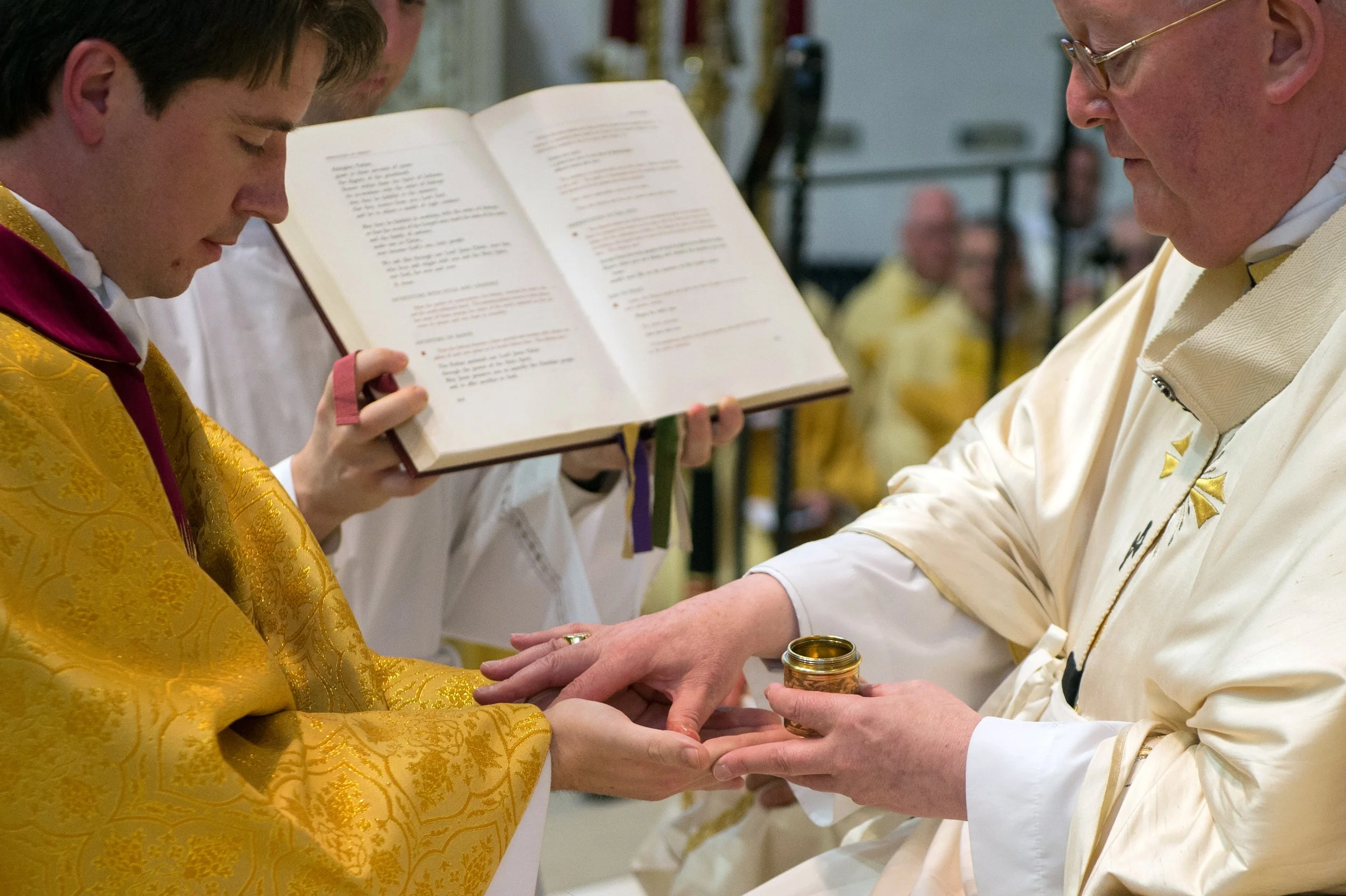
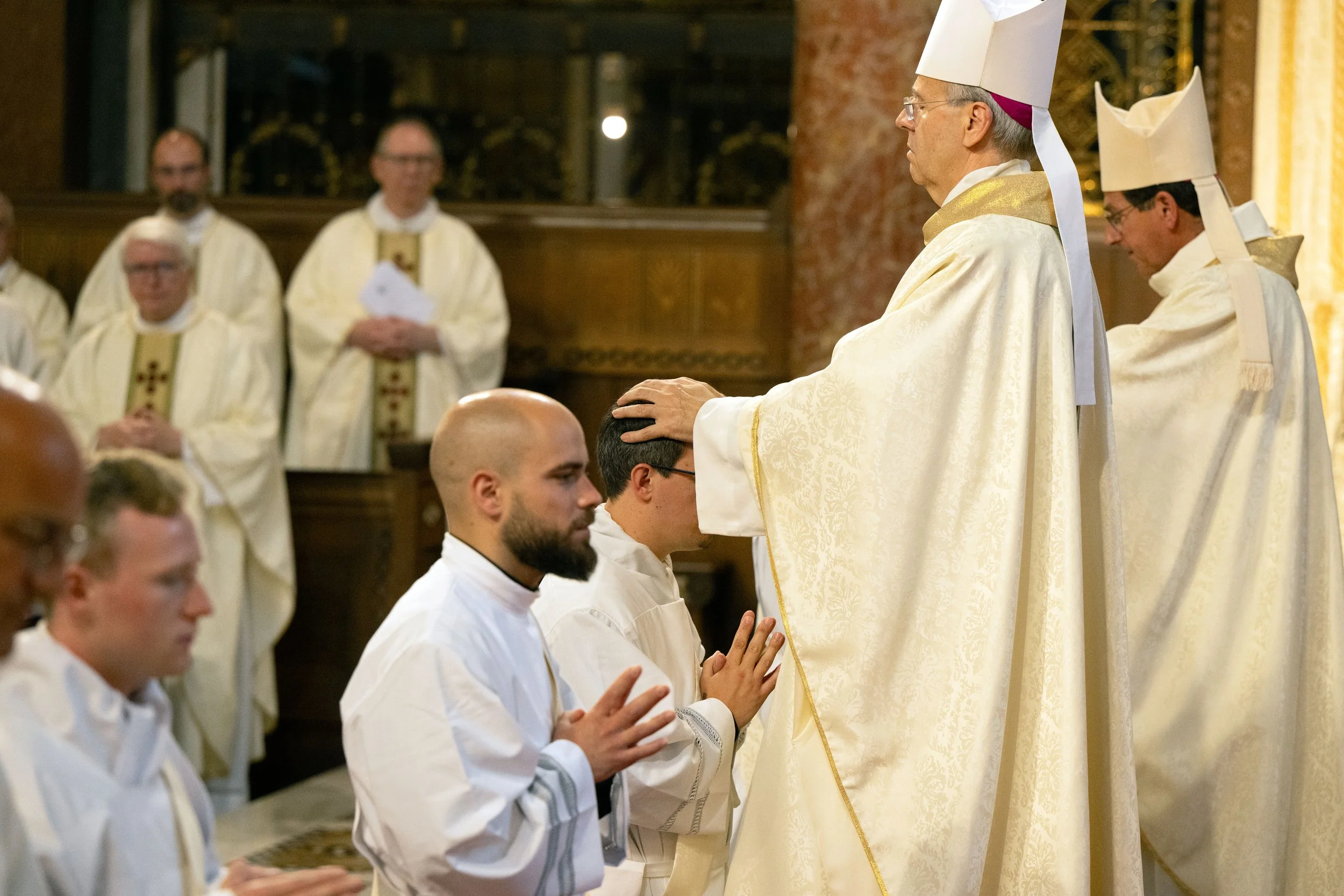
At his ordination to the priesthood, the newly ordained kneels before the bishop, who anoints the priest’s hands with the Oil of Sacred Chrism. Customarily olive oil bound with resinous balsam, this anointing represents something of an imparting of the Cross of Christ—the principal sign of Christian sacrifice—which the Fathers of the Church often describe as being hewn from an olive tree. This liquefied form of the Cross is smeared onto the palms of the newly ordained as a sign of his perpetual and eternal consecration, not simply as an ecclesiastical functionary, but as a priest; that is, as one set apart—himself consecrated—for the offering of sacrifice. Indeed, this is why his hands are anointed, for it is in them that he will hold the very bread of life and the chalice of salvation.
As this anointing takes place, the bishop says: “May the Lord Jesus Christ, whom the Father anointed with the Holy Spirit and power, guard and preserve you, that you may sanctify the Christian people and offer sacrifice to God.” The bishop’s prayer for the newly ordained to be protected by God is no mere pious wish. Rather, it asks for the safeguarding of this man—the bishop’s priestly son—in order that he may perform a very specific, twofold function: sanctify the Christian people, and offer sacrifice to God.
© Mazur/cbcew.org.uk
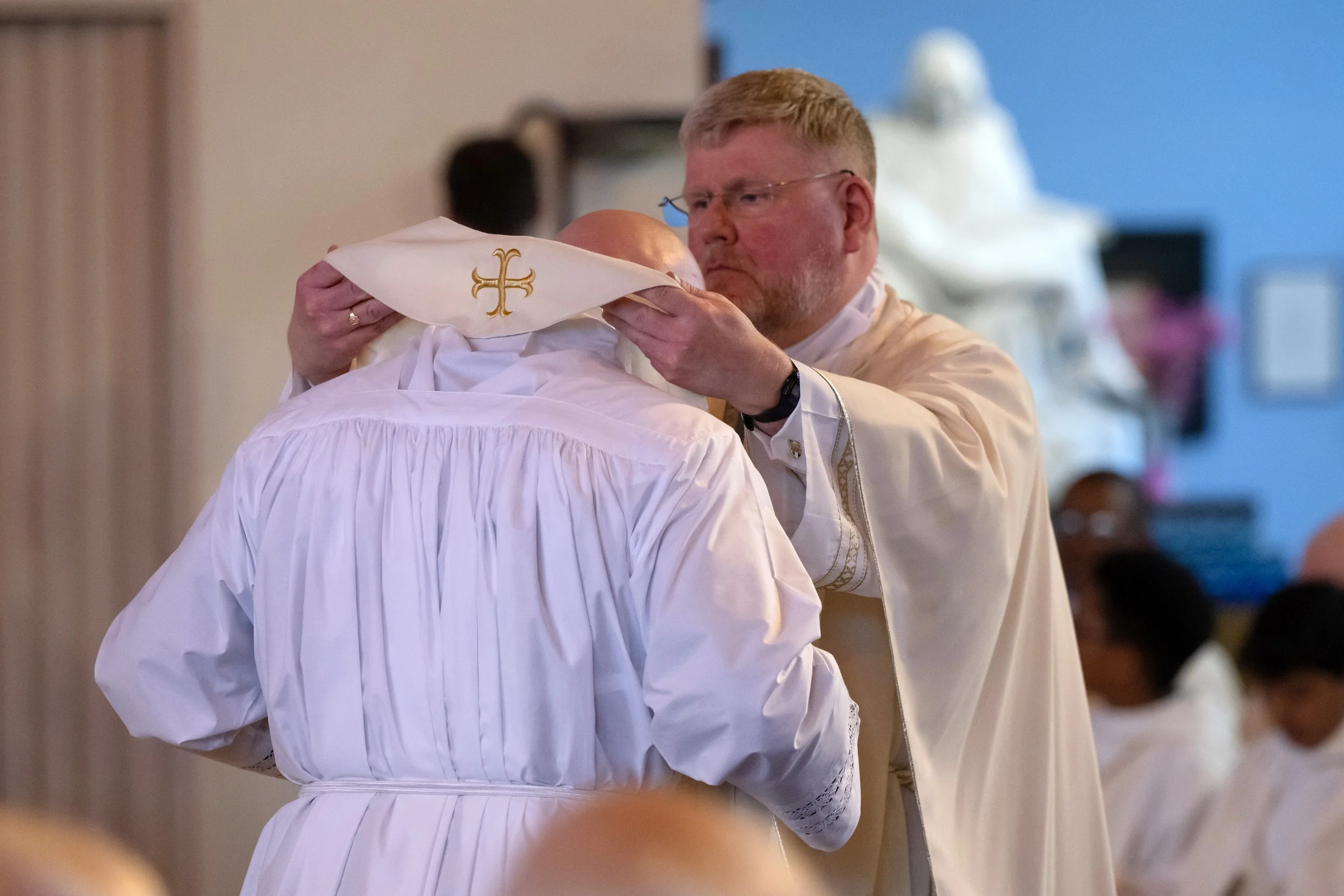
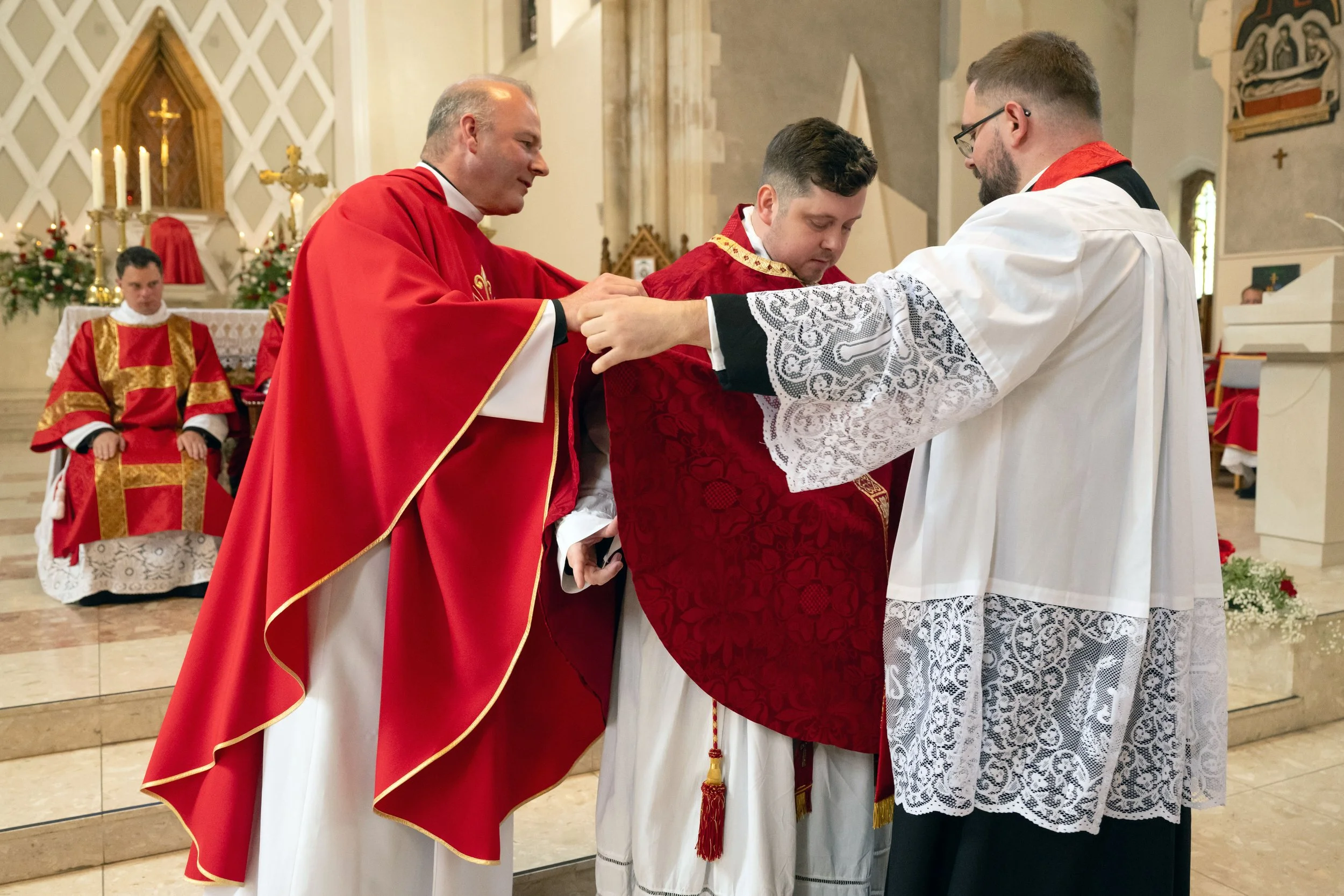
In fact, the action that immediately precedes this unction elucidates the first of these tasks. Immediately before the anointing, the priest is clothed with the stole and chasuble. The stole, of course, has already been worn by the man since his ordination to the order of deacons, albeit in a different way. The chasuble, however, is altogether newly his. At the Chrism Mass in 2013, Pope Francis explained the origins of this vestment in the robes of the High Priest. These garments were adorned with two onyx stones, set in gold and inscribed with the names of the children of Israel, which were in turn placed on the two shoulders of the ephod (Ex. 28:9). On the High Priest’s central breastplate were twelve further precious stones—all of them different—on which were written the names of the twelve tribes of Israel (Ex. 28:17–21). As Pope Francis went on to say: “This means that the priest celebrates by carrying on his shoulders the people entrusted to his care and bearing their names written in his heart.” Indeed, the chasuble (which takes its name from the fact that it envelops the priest like a ‘little house,’ casula in Latin) reminds the man that he acts not only for himself—it is not his priesthood; not his Mass—nor only for the immediate community at prayer or entrusted to him by the bishop, but rather for the entire household and family of God, which is the Church of Jesus Christ.
© Mazur/cbcew.org.uk
While this symbolic act of vesting and then anointing takes place, the chant appointed to be sung recounts the fundamental and scriptural basis of the priesthood of the new covenant, thereby evoking the second of these tasks: “Christ the Lord, a Priest for ever according to the order of Melchizedek, offered bread and wine” (Psalm 110 [109]). The connection between this text and the new priest’s own life is made still more apparent in what follows: the handing on of bread and wine. As Pope Pius XII declared, this action has no sacramental effect (Sacramentum ordinis 4), but it nevertheless possesses a profound symbolic value. The bread and the wine are brought forward by some of the faithful—the bread on its paten, and the wine mixed with water for the celebration of Mass in its chalice—and given to a deacon, before being handed by him to the bishop. From the people, to the deacon, and then to this successor of the apostles, the fruits of the earth and of the vine that will shortly be offered in precisely the eucharistic sacrifice for which the man has just been ordained, are then handed on once more (literally and figuratively), now to the new priest. Again, the instructive words of the ordaining bishop to the priest explain more fully the purpose of this ritual gesture: “Receive the oblation of the holy people to be offered to God. Understand what you will do, imitate what you will celebrate, and conform your life to the mystery of the Lord’s Cross.”
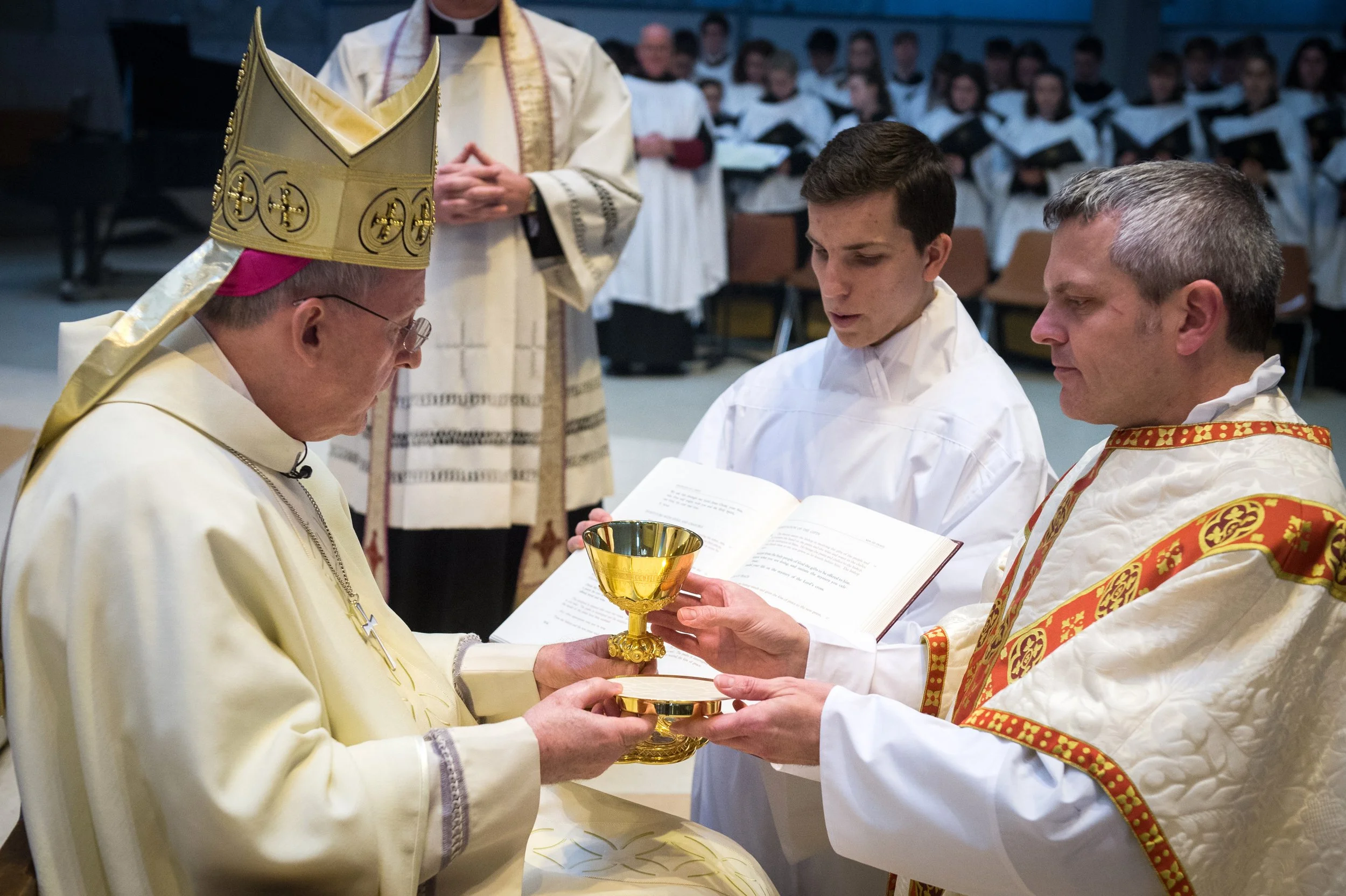
© Mazur/cbcew.org.uk
This triptych of imperatives—understand, imitate, conform—depend on one another, and also communicate to the new priest the importance of his lifelong fidelity to the living Tradition of the Church. Knowledge, comprehension, and belief in what one does; faithful embodiment of that reality in one’s own life; humble union with the offering of the sacrifice itself. This is a dynamic task of reception, embodiment, and transmission, not individual creativity, arbitrarity, or essential change.
These poignant signs at the start of a man’s sacerdotal life help to imprint on his heart the model he is bound to follow for eternity. His consecration for the offering of sacrifice, and so by extension for the sanctification and edification of the Christian faithful, is his deputation as homo liturgicus in a new and essentially distinct manner. From this moment forth, he is configured for divine worship in a special and unique way, and entrusted by the Church with the performance of sacred duties. The Code of Canon Law describes this worship well when it says that it is “carried out in the name of the Church by persons legitimately designated and through acts approved by the authority of the Church” (can. 834 §2). In other words, the deputation to serve received in ordination, and the acts of service themselves, are not the priest’s own, but belong instead the Church’s deposit of faith; the mystery of Christ (can. 760).
This liturgical and theological foundation of the priest’s life manifests itself in particular ways from the day of his ordination through the man’s ongoing and lifelong fidelity to the prayer of the Church. The Liturgy of the Hours is, as the name suggests, a liturgical means of sanctifying time. If it is liturgical, then it is also public: a work “carried out by the Head and members of the mystical Body of Jesus Christ” (can. 834 §1). The priest is not called on to recite these prayers only for his own sake, but precisely because of his stable and permanent deputation as a cleric; an official minister of the ecclesial society of the Church, consecrated in its service, whose first duty is therefore to offer worship for the sanctification of the Christian people. And it is found, too, in the daily celebration of the Mass, which even if he must offer it alone is always— as Pope Paul VI explained—“an act of Christ and of the Church” and “not something private” (Mysterium fidei 32).
© Mazur/cbcew.org.uk
For those prayerfully considering offering themselves for ordination in the Catholic Church, this sense of being consecrated for sacrifice is something on which to reflect. The priesthood is not a thing to own or to possess, but a treasure to receive and to take on. It is, at the same time, a yoke and a burden; one that demands a man say with the conviction of the Apostle, “It is no longer I who live, but Christ who lives in me” (Galatians 2:12). It requires a subduing of the self, not so that I may become nothing, but so that I may become Christ; the grain of wheat that falls into the earth and dies, precisely so that it may bear much fruit (John 12:24). It is a setting-apart from within, but never fully apart from, the whole of the people of God, principally for the offering of divine worship, so that by a selfless act and permanent gift of love for God and for neighbour, our brothers and sisters in Christ may experience more fully the fruits of his sacrifice in and through the liturgical and sacramental life of the Church.
Of course, none of this means that the priest is uniquely concerned with the strictly liturgical tasks of prayer and sacrifice. He is also to teach and to govern in the name of the Church, and to do so as a faithful collaborator of his bishop. These tasks require their own formation and conscious, committed sense of self-abnegation: the setting aside of personal opinion in favour of the Church’s doctrine, and the rejection of capricious power in the service of that which is just in the Church’s law. But these offices, ministries, or functions also find their origins in a sense of being consecrated and deputed, called and sent. And it is in the heart of the ordained priest truly committed to this sense of sacrifice, that the authentic happiness of a man’s vocation may be found.